41 | Contrary Action

1981 | Into Death Valley from the East

1981 | Into Death Valley from the East

For me, driving is not the same as finding pictures. The far-forward view of the attentive and anticipatory driver doesn’t often pay off in finding vantage points. The narrowed view, the speed, the isolation from physical textures of pavement, gravel, soil, grass, the odd debris or artifact, all conspire against my apprehension of a physical relation to the place.
So at some signal, or point, or level of fatigue, or frustration with driving so far without stopping for a picture at every impulse, I pull over.

Once my feet are on the ground, it’s a matter of feeling and seeing what kind of road I am on, and how it might match up with my personal path through this landscape. When my own path seems congruent, lightly and transparently superimposed on the surveyor’s map, then there might be a picture for me.

That doesn’t really explain why I find this view of this particular stretch of road so engaging, but I know it qualifies to be in my folder marked ‘Odd Highways.’

40 | Truer Perspective

1980 | Shasta Dam, Photographer, Penstocks and Spillway Detail

1980 | Shasta Dam, Photographer, Penstocks and Spillway Detail

This has been one of my favorite ‘maybe-good’ pictures since it was made. One of its aspects became more clear to me much later, when I projected it on a big screen for an artist’s talk. I used to think that my picture showed the futility of the man in front of me, trying to photograph the dam with a Pocket Instamatic. From a healthier perspective, more truthful in front of my audience, I noted the layered futility of my own effort to work the scene with a modest 6x9cm rollfilm camera.

As is often the case, the joke is actually on me, but the puzzle and the prize is in the broad search and the focused effort toward crystallizing an experience.


It’s always relative: the frame of the Pocket Instamatic is 13 x17mm, the frame of my camera was 56 x 84mm, and the downstream face of Shasta Dam adds up to 13 hectares, or 33 acres, which is about 28 million times the area of my ‘larger’ negative.

And the dam might have been even larger; the confluence of the Pitt, McCloud, and Sacramento Rivers forms a huge basin – engineering-wise, one of the best dam sites in North America. The dam was originally proposed at a height of 800 feet, to impound three times as much water as the one that we see a portion of here. Building this huge mass in concrete required copper piping cast in place, with chilled salty brine pumped throughout, essential to cure the material in less than 100 years. Copper shortages and labor restraints imposed by the Second World War reduced the scale, and the dam was completed in 1945 at a redesigned height of 602 feet.


*I am grateful to the John Simon Guggenheim Memorial Foundation for generous support of my extended photographic survey of California water resource management during the years 1980 and 1981.

39 | Life Cycle

1980 | Feather River Fish Hatchery, Oroville

1980 | Feather River Fish Hatchery, Oroville

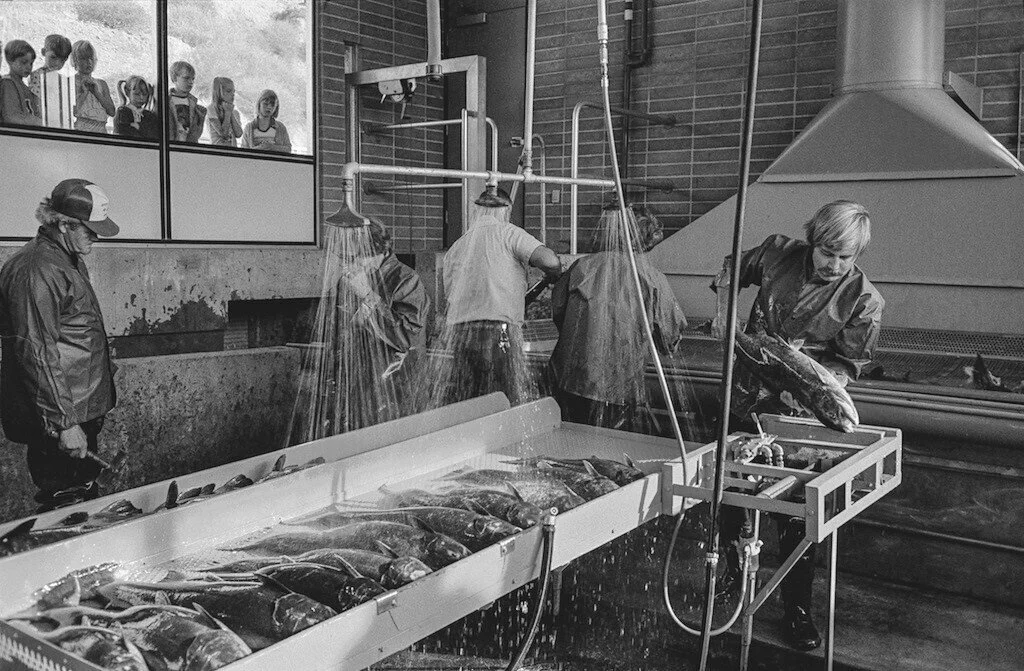
The Oroville Dam was built with a specialized system of inclined intake towers to manage the temperatures of its outflow. Warmer water is taken from the upper levels in the reservoir to meet the requirements of rice farmers in the Butte County flatlands below. This fish hatchery requires much colder water from the deeper parts of the reservoir to simulate one of the primary conditions that king salmon would seek in their dam-eliminated spawning areas.

When I visited, this hatchery sacrificed and manually arranged for milt and eggs to be ‘mated’ for about 5,000 mature kings during their brief but intense spawning run (these were the far and fast swimmers; about two-thirds of the run now spawn naturally in areas below the dam). Normally the strongest would have gone much farther upstream, found suitable and safe gravel, made nests, spawned, and then died; their drifting or snagged remains might later be consumed by young ones for valuable nutrition during their return to the sea, where they in their turn might make three or four or sometimes five or more circumnavigations of the Pacific before returning to the highest and coldest waters of their home stream.


(From an entry in my water survey notebook, October 30, 1980.)

38 | Museum Studies

2013 & 2014 | San Diego Natural History Museum


I am partial to the Balboa Park Museums in San Diego. They are tightly clustered and remarkably different in their curatorial attitudes and display schemes. There is something going on every time I go in.

This one was taken in the Natural History Museum, which is in no way musty or conservative, though it was founded in 1874 and has been been in the same spot since 1933.

In our old days in the 1980’s, my kids prowled through here. One day, we encountered a display of the research and conclusions on plate tectonics. In the mid-1960’s, our tough earth science courses at UCSD were laying out the “continental drift theory” for us, and just down the hill at Scripps Institution of Oceanography, research vessels were still bringing home revealing data on mid-ocean ridges and seafloor spreading. Barely twenty years later (not even a generation), the geological picture had become irrefutable, and in this museum, my kindergarten-son knowingly watched an animated video of how Pangaea recently became our present catalogue of continents.

The first picture here, like many, may not be about anything in particular, but I always try to notice when a mountain lion is in the room. After all, it’s their territory.


* Run your mouse over the picture to exchange the two pictures.
** Touch-screen users can just touch the picture to swap, then touch the white border to revert.


The American lion in the second picture, though extinct for 10,000 years, still bears watching – in that time, besides other humans, the big cats were our top predatory threats. I wonder if that has anything to do with our own habit of keeping miniature versions of them as house-pets these days.

37 | Natural Science

1994 | Anza-Borrego Desert State Park

1994 | Anza-Borrego Desert State Park

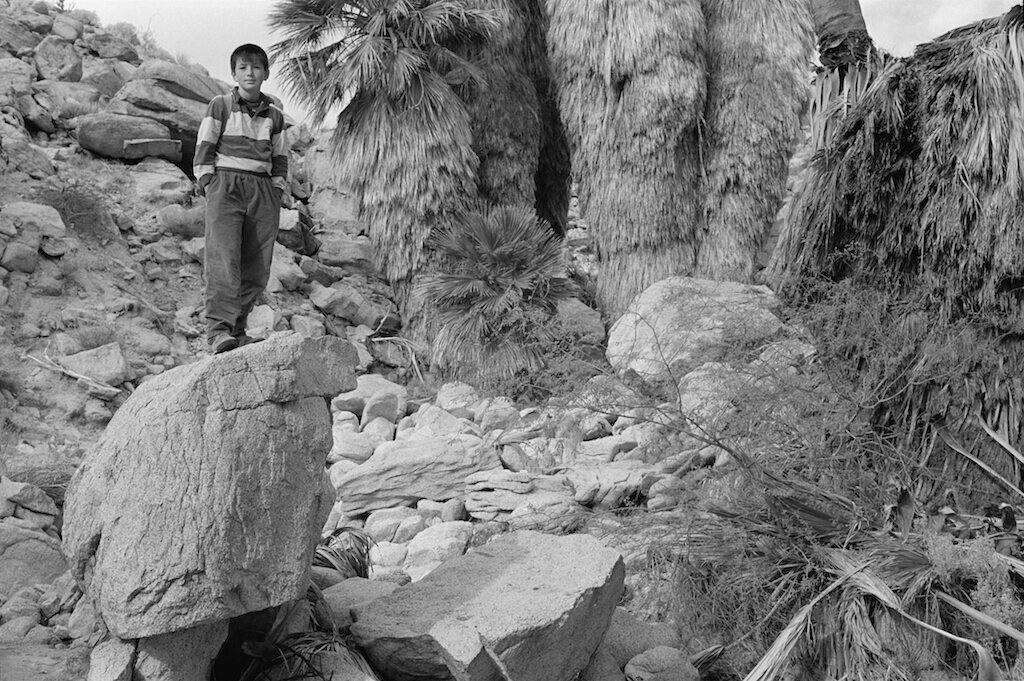
My son has been a fine camping companion for all of our years together. He learned early on that he was not required to bathe every day when we were out on the road and up on the trails. Our Guy Rule was that we had to stop regularly near water to dip the dust off, places not always obvious in the bright and dry Southwest. Alex was an early and avid reader and grew into a sharp navigator, poring over maps and camp rosters to find remote spots likely for water at cooler elevations.

One year, Alex was booked to fly back from Salt Lake City to rejoin his mother so that I could drive on to the coast to lead my annual summer workshop near Cape Blanco. I suggested that we could stay in Provo so that he could sleep in a bed and have a proper shower before his flight the next day. What I heard then was, “I refuse to stay in a motel!”

He went into his camp guide and found us a perfect Forest Service site high in the nearby Wasatch Range, with a vigorous trout stream and a generous pile of split and seasoned firewood, with no neighbors for miles. We learned some of the language of that stream as we drifted off that night, and a little more of it as we awakened.

Nowhere near driving age yet, Alex also spent time in the cab as our expedition naturalist. I remember that we acquired a copy of “The Poisonous Denizens of the Desert” and that he had devoured its pages. A few years later, we met scorpions in our camp. I asked Alex what he could remember from his earlier reading, and he reported that the smaller, translucent ones were the most poisonous. I asked if their sting would be fatal. Always on the case, he replied, “Only if they get you in the neck.”


36 | A Father's Day

1983 | Del Mar, California

1983 | Del Mar, California

My daughter enjoyed our many photo-sorties together, and she came to develop a fine and sensitive eye of her own, bringing back pictures all the way from India and all through the long continent spanning Panamá to Tierra del Fuego.

Before her photography took hold, Emily found her own inspirations when my camera was along. At Quail Gardens, I liked to work up the dense tropical sections. After I had set up each view, she would take my focusing cloth for a wizard’s cape and make magic in the deepest and darkest corners of the place.

This picture was made later that same day in Del Mar, a few months before my son arrived to join us in the world. By the calendar, it’s not a Father’s Day picture, but it works like one as I look back thirty-seven years to its irrefutable evidence – my daughter and I were working differently with the same material, but we found our own access to a shared message through separate windows.


35 | Stonecyphers

1991 and 1998 | Marble Canyon Narrows, Death Valley


* Run your mouse over the picture to find the second view.
** Touch-screen users can just touch the picture to swap, then touch the white border to revert.

34 | Family Matter

1985 | Low Tide, Marin County


This shows my mother and my daughter investigating the intertidal life along the west shore of Tomales Bay. I hadn’t really looked at this batch until I recently began re-scanning from my entire film archive.

Either version works for me. I have queried others in the family, and though united in their affection for each other, they are divided on which one of these versions is a better representation of dear people in a special place.


* Run your mouse over the picture to compare my two views.
** Touch-screen users can just touch the picture to swap, then touch the white border to revert.

33 | High Expectations

1980 | Foresthill High Bridge, North Fork American River

1980 | Foresthill High Bridge, North Fork American River

California Highway 49 crosses the North Fork of the American River here. Seven hundred and thirty feet above the water is the Foresthill High Bridge, constructed in the early 1970’s to clear the anticipated level of the reservoir behind the proposed Auburn Dam.

When I first explored this area, along the western foothills of the Sierra Nevada, I was puzzled by the passing of many VW Beetles with surfboards on their roof racks. After pulling over at this view and getting on the ground, I saw several prospectors running small gas-powered dredges, updating an old California art. It turned out that the kids in the VWs were coming up after class with their fiberglass sluice boxes to do a little panning for gold, which is still washing down in traces from the old lodes.


32 | Excavation

1980 | Diversion Tunnel, Auburn Dam Site

1980 | Diversion Tunnel, Auburn Dam Site

Water issues were the first order of business in the new California legislature in 1850. Then in 1862, newly-elected governor Leland Stanford was rowed to his inauguration, since the capital city of Sacramento in the Great Central Valley was under six feet of water.

Flood control has long been a concern here. Hydrologists and engineers will all tell you that in California, ‘’there is no such thing a normal winter.” The dramatic increase in population in the 20th century brought more concerns, since seventy-five percent of the water supply is in the north, and the majority of the population settled and grew in the south.

The North Fork of the American River produces prodigious flows during rains and rapid Sierra snowmelt conditions. Considerable planning went into finding a damsite to optimize flood control to support and protect downstream dams.

Proposed in the 1950’s, work began in 1968, but by 1980 the Auburn Dam construction site had become dormant, a kind of geological museum; the deep excavation cuts cleanly through a previously unmapped fault. The excavations had been made for abutments of a concrete thin-arch dam, but an earthquake in 1975 raised public concern about the dam design and construction was halted. Cost questions followed, then environmental concerns. But core-sampling continued, and a huge warehouse nearby catalogued the specimens, which provided a unique highly-detailed study of the entire site.

If a dam is ever built there, the decision will be made politically, and the plan may be for an earthfill or a concrete gravity structure instead. When I asked a thoughtful Bureau of Reclamation official when he thought the Auburn project might get the go-ahead, he told me, “Right after the next flood.”


In this picture, at the lower right is the discharge from the diversion tunnel, which was to carry the full flow of the river during dam construction. A flood in 1986 overwhelmed the tunnel’s capacity and eroded the cofferdam, which was designed with a flow-metering wash-away section. This broke through quickly, and the huge flow rammed down to Folsom Dam and on to the distant Delta levees. These barely held and were afterwards re-rated for a much lower flood threshold.