11 | Answering the Color Question – A

1994 | Mesquite Flat, Death Valley

1994 | Mesquite Flat, Death Valley

Following up on how people ask, “Should I work in black-and-white, or in color?”

I look at the spare yet intricate monochrome pictures of Lewis Baltz. If you can get to his prints, they are supremely nuanced, especially in the very high and very low tonal registers.

His own answer to the question is one of the best: “Black-and-white has more colors.”

10 | Asking the Color Question – A

2002 | Tokyo-Ikebukuro

2002 | Tokyo-Ikebukuro

Some people ask, “Should I work in black-and-white, or in color?”

The answer might seem to be in one’s intentions or expectations, but it is found in the results.

A student once asked Ben Lifson how to use color. He replied, “Just like black-and-white.”

So for me, that means if I seek the additional layer of color content, I should never give up my concerns for expressive tonality and the critical figure-field relationships needed to describe a 3-dimensional illusionistic space.

9 | Michael Jang

2014 | Michael Jang opens at KesselKramer, Los Angeles

2014 | Michael Jang opens at KesselKramer, Los Angeles

Michael and I were tossed in together when CalArts opened in the fall of 1970. The campus (although in temporary, endearing quarters in Burbank) was born whole, brilliantly admitting students from high-school seniors through all levels of graduate study, with all their earned credits. Many of us dropped what other programs we were pursuing to join this remarkable startup.

So, from different ends of this range, Michael and I joined Ben Lifson’s photography critique. Ben’s passionate expectations and encouragement were baked into the quality and durability of our own efforts over our long careers.

Michael has been hugely productive, and it’s always good to see what he has been up to, as our work comes from different angles. I am glad to have this picture of him hinting at how I think he is – whimsical, audacious, committed.

*If you don’t know who Michael Jang is, I encourage you to take a look at his new book. (Atelier Éditions, 2019)

8 | Playing the Game

2003 | Berkeley, California

2003 | Berkeley, California

Back in the 1950’s, as children, we spoke quite a bit of Pig-Latin. We don’t hear it much anymore.

It’s very rare that we ever see it.

6 | Reading

2018 | Marin County, California

2018 | Marin County, California

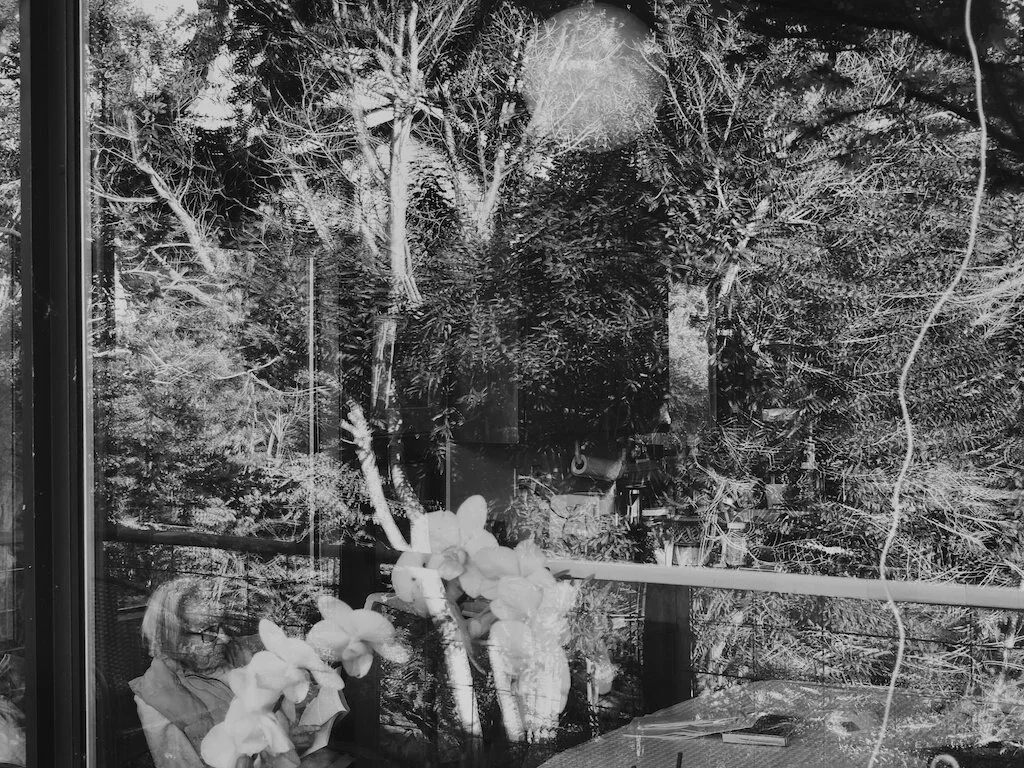
I had no intention of photographing on this workday. I was intensively remodeling my mother’s little house to make it more comfortable for relatives and caretakers to stay with her. Early in the day, at my workbench out on the deck, I had cut some difficult mitered pieces for the interior trim. Carrying these, along with an armful of tools, I found the sliding door still locked from the night before. As I retreated to set my things down, the extra distance gave my eyes room to work. The device in my pocket had poor phone coverage in this rural area, but its camera was my best tool that day.

Here, my mother is reading Jhumpa Lahiri. I think the book is our favorite: “Interpreter of Maladies.”

4 | Roadside

John Szarkowski wrote that a photograph describes everything, but explains nothing.

Aily, a second-grader, wrote to me that she liked that I had shown her class my “puzzle pictures.”

1978 | US-40, View NE, Colorado

1978 | US-40, View NE, Colorado

3 | Appearances

Some say that the most important part of a painting is “the part where nothing is painted” – in photographs, I am intrigued by a part of the picture with legitimate detail, but where nothing is readily decoded.

I love pictures, or parts of pictures, where areas are faithfully described by the lens, but somehow the eye still struggles to resolve them.

1979 | Anza-Borrego Desert State Park

1979 | Anza-Borrego Desert State Park

2 | Classroom Learning

As a visiting artist I enjoy presenting my work to unfamiliar audiences. I don’t try to “explain” my pictures, but instead I describe how they come about. I feel especially at home talking with youths; they are a valuable resource for me. I am touched by the bright eyes and light voices of little people with big curiosity.

Recently I paid a visit to a second-grade classroom. We looked at more than a hundred of my examples, and I claim a school-wide attention-span record. There were many enthusiastic questions, and in response I gave some “advice” to photographers. I showed this picture of my battery-dead Leica, explaining that I had continued working, differently, with the properly-charged phone taken from my pocket. Then I recited the time-worn answer to the old question, “What is the best camera? – It’s the one you have with you.” 

A few days later, I received a generous packet of fresh and insightful letters of thanks. One girl’s comment stands out today as the truest answer to that question – my answer, for all those years, had been far off the mark.

Charlotte B. wrote to me: “I learned that the best camera is the one you hold.”

2010 | Marin County, California

2010 | Marin County, California